Our Idling Economic Engine

“Economy” is defined by Merriam-Webster as “a thrifty and efficient use of material resources”. Other wordings of course exist, but I feel this one does the best job. So when we say “The economy…”, we’re really saying “The system we’ve designed to utilize resources in an efficient way.”. Now this makes sense, given that through Capitalism and the pursuit of profit above all else, we essentially mandate efficiency. On paper, this sounds like a good setup. But I see a problem with the definition of the word economy; one that, as far as I can tell, is responsible for  a substantial barrier to the reliable creation of prosperity. That problem is purpose, or rather, a lack thereof.

An economy is just a method of using resources efficiently. A working, stable economy is simply a working, stable method of using resources efficiently. What it lacks is purpose; direction. So what if we’re stupid good at using resources. We could, if we so chose to, create a production process and allocate materials for the purpose of producing a rubber ducky for every man, woman, and child on the Earth, and we could do so with a ridiculous degree of efficiency. We could iterate the design to use less material, streamline the production processes to minimize human involvement by designing modular, robust and scalable automation, and establish highly-automated dynamic systems for the transportation and delivery of our duckies. We could do all this, and we could do it in a stupid efficient way, if we so chose. But I think it’s pretty clear that this course of action absolutely does not constitute an efficient use of resources. Not that rubber duckies aren’t awesome, of course.

As I see it, there are two elements at play here. ‘The economy’ as it’s traditionally understood: The production chains, infrastructure, and organizations that make stuff happen. Then there’s the seemingly overlooked ‘purpose’ element. The direction, the foreman, the brass. The decision makers. We call them ‘job creators’.

This is our chosen method of divining ‘purpose’: We provide resource access (cash) to those who demonstrate themselves to be worthy of wielding resource access (those who achieve financial success), and then those people choose what resources should be used to what ends. Elon Musk, for example, could have chosen to pursue DuckX instead of SpaceX, making it his will to create and provide not cheap rockets, but free duckies instead. It’s his money, it’s his prerogative. Luckily however he chose to do something that most people would agree is a “good use” of resources. Unfortunately for every Elon Musk there are dozens of Donald Trumps and Kevin O’learys who choose to use their resource access in the pursuit of more resource access, instead of striving to achieve meaningful progress.

Now that’s not to say those kind of people are useless. You don’t acquire a fortune by being useless. But they have chosen to profit from exploiting problems, instead of solving them. There are people who seek to make a difference, and people who seek to make a profit. One directly solves a problem by applying resources in an efficient way with the goal being the solving of the problem. The other exploits the problem by creating a solution and working to maintain control of it, not really aiming to solve the problem, but seeking to create a perpetual sort of fix. A good example of this is telecommunications companies in Canada.

You would think the point of creating a telecommunications company should be providing telecommunications services to people. It’s not. The point is to make profit. We have the technology, the know-how, the resources (material and human), and the demand to establish and maintain state-of-the-art communications infrastructure, and yet, the state of internet infrastructure and service in this country is dismal. Why? Because a few companies have found it’s much more profitable to artificially limit the technology; to abstain from striving to provide the best we can create, and instead pursue a perpetual oligopoly and profit by over charging for an artificially scarce resource.

My point is this: There is no one unified effort to use resources to achieve the things we democratically decide we want to achieve. The closest thing we’ve got is the much despised government and the constant battle to fund/defund projects. We have no business calling the economy “the” economy, as it’s not. There’s Musk’s economy. There’s Trump’s economy. There’s my economy, and your economy. Our world; our very notions of freedom are built upon the idea that what I do in my home or business with resources that I’ve attained control over is nobodies business but my own. If I want to build rockets or mass produce duckies, and I have the resource access required to do so, then nothing aught stand in my way.

A colony of ants could be said to have it’s own economy. Many resources are used to maintain a colony, and each flows efficiently to where it needs to be. In a natural ant colony millions of autonomous individuals collaborate to construct, expand, and maintain a colony. Each ant, on it’s own, is able to decide where to go, what to do, and how to go about it… and yet, each seems to follow a very strict set of rules. Ants communicate via scents and movements and are able to relay complex instructions very fast. As such they can react very quickly to changing circumstances. Together, they are able to build vast societies with millions upon millions of individuals and often times bountiful stores of valuable resources. What is it about ants that allows this degree of natural collaboration? Is it the queen? Or just their natural instinct? If our countries were ant hills, and businesses were ants, what would our colonies look like?

Our ants, our businesses, are too autonomous. They too have strict rules in place to govern their operation, however, their rules are for the most part self-imposed. We have no all-powerful entity directing the actions of our ants (at least since we discovered that monarchy doesn’t work so well for us). Our queen is demand. Our instinct is to profit. Our ants perform based not upon what needs to be done for the good of the colony, but rather, what provides the most to the individual. We have millions of highly capable, competent entities each tugging their own direction, using resources for their own personal gain and relying as little as possible on the others. Tunnels would be dug, food collected, young cared-for based not on what would result in the most powerful, efficient colony, but what would provide the most immediate gain for the individual doing the work. It would be absolutely efficient in the eyes of the individual ants, but chaotic and ineffective as a whole.

This situation exists at the same time that we’re trying to rationalize the idea that “the economy” is the thing that creates prosperity, when in reality, it’s individuals with passion, ideas, and resource access that create progress. The economy simply facilitates that by enabling the flow of resources and labor. It’s not the pump, pipes, faucet, or hose that grows crops, but the will of the farmer and the availability of water. Of course sturdy tools and infrastructure make a huge difference, the point is that given water and space, the farmer’s own hunger will drive his efforts. In the same way, given the resources and time, a human’s own desire will drive their innovation.

The system that we have now is designed to ‘weed out’ those who are not passionate. Who would squander resources. Who would be inefficient. But we go too far. We should not relegate those who are not so obviously worthy of resource access to a life of poverty, but rather, a basic existence with avenues to achieve something more, should the desire ever come. Even those who may seem useless may just have some untapped potential. Instead of casting them aside because of their refusal to seek it out, we should provide them with dignity and allow them to live. One day they may decide to do something more with their lives, but until then, they aught be comfortable at least. Lest they lose interest in participating in our society at all. A refusal to pursue profit should not be treated as a refusal to be productive. Most of us want to be productive, but can’t quite seem to find the circumstances that work for us. Many of us wish to solve problems, but to do so one must pursue profit. If people could simply choose to use their time and brains when they wanted to pursue what they wanted, I suspect there would be a lot more output from the “takers” of this world. Not profit mind you, but tangible progress, and perhaps more importantly, genuine happiness and fulfillment.

We purposefully reserve the ability to have a meaningful impact for those who demonstrate themselves to be worthy of such an ability. And yet many who attain this ability demonstrate themselves to be anything but worthy of it through greed and decadence. A world could exist where resources are allocated based on the merits of what they are to achieve, instead of the whims of those who manage to accumulate funds. We could create the means to live from birth to death in a dignified way on a massive scale, in the same way that we’ve created processes to supply automobiles and cellphones to every corner of the Earth. We have the potential to create an economy that is absolutely capable of allowing us to mass produce robotic automation in abundance in a very efficient way. What we lack is the will. What we lack is purpose.

The engine is running, but we’re too busy bickering over who gets to drive to decide where to go.
New Is Not Always Better

Our new methods of doing industrious things are unarguably “better” than they were historically. We are more productive, more efficient, and more capable than ever. And yet, the work we do seems to do less and less for us individually despite us working harder and harder. How can this be?

A common response to the suggestion that robots will take jobs is that new jobs will come about. Dozens of times I have heard “labor saving innovations free people up to work on new things”. I have never been able to understand this argument; I just don’t get it. Choosing to work towards pioneering new types of work is totally separate from working a job. A job is a prerequisite to eat. Pioneering a new field is a product of passion and genuine interest. But it requires resources and time. If you want to see people coming up with new things to work on, you must provide them time, resources, and challenges to overcome. Jobs provide resources while consuming time. Most jobs provide barely enough resource access to satisfy basic necessities, forget having excess to use in the potentially wasteful pursuit of new types of work. For the lions share of people, being displaced by a machine means a frantic scramble to find new employment and failing that, a slow decline into poverty and despair. Certainly not an opportunity to create and innovate.

Food production used to be everyone’s ‘job’ in that if you failed to feed yourself, you didn’t last particularly long. We used to forage and hunt for 100% of what we ate. Sounds time consuming, especially if you have a big apatite. But then… Primitive automation!! Well, not really, but… The shift from foraging to farming could be seen as a labor saving innovation. So that meant more available time, which meant people could to do things other than attain food. Early farming would still have been a lot of work, but at the very least it was closer to home. With this new found time one of the first ‘new things’ that people decided to work on was undoubtedly better farming techniques as that would directly translate into more food and thus more time.

Okay so that sounds pretty supportive of the argument that automation creates new work. Labor saving innovation = more time = more work as a result of having time to do it. But let’s be clear here… That ‘more work’ came about specifically in the pursuit of more time. The reason one would decide to use one’s new found free time to improve the process that brought about that free time in the first place would be: More free time. Free time would seem to have been the goal. If so, we have most certainly lost sight of it.

So it’s true. In the budding days of agriculture, the labor saving innovation that was ‘collect seeds and plant them closer to home’ did indeed ‘free people up’ to work on other things. First, to improve what had brought about the free time, and then other things like smithing, tanning, weaving, sciences, etc. Each of these instances would have followed a similar trajectory. At first, the going was tough, and the fruits of the labor were scarce. Early smiths had to pioneer the techniques used to create and work decent metal. The first tanners had to figure out the best way to prepare hide for further work. Prior to the scientific method, experimentation would have been haphazard at best. But through innovation and refinement these processes were improved, not unlike the aforementioned methods of food production. Before long skills were developed, techniques established and refined, and the focus shifted from just simply being able to do it to instead being able to do it efficiently. In other words, once we got the basics down pat, we began seeking ways to reduce the required input… or create more free time for ourselves.

And we did…

Now labor saving innovations have ‘freed’ those craftspeople (or, rather, their descendants) to… wait for it… flip burgers, stock shelves, and man cash registers! These jobs, when compared to the previous occupations, seem like a bit of a step down. Further, there is plainly less involvement on the part of the worker. Where a smith would apprentice with a mentor to learn and master a skill, a cashier simply gets a quick overview and is left to figure it out. Comparing the substance of the jobs reveals that one is a meaningful effort; work which requires the attention and skill of a human being, and the other is nothing more than hollow, no-skill busywork. Is this what we have to look forward to?

A smith might work to improve his/her process so that they could access more of their time. What they choose to do with this time is irrelevant, be it further innovation, more work,  or personal enjoyment. The point is that it was an option. It is not an option for someone who works in retail. In their case, the work of improving the process falls to another person, and should that person be successful in lessening the workload it results in less work (thus income) for the retail worker. The retail worker is in a position where it’s a bad idea for them to innovate, as it will directly translate into less need for them. As such, it’s no surprise to see the attitude towards work changing in the way that it is. Gone are the days of being true to one’s employer, of feeling like one is truly a vital part of something bigger. These days, one is expected to feel this way as a prerequisite to employment. One is expected to be a team player; to act like you are onboard with their goals, prior to even being hired. Instead of a company demonstrating it’s commitment to it’s employees and being rewarded with their loyalty, loyalty (or at least the illusion of it) is now just another prerequisite.

This next ‘phase’ of ‘workers being freed up’ by automation will have them go where exactly? Should we expect another step down for the millions and millions of people who find themselves already in these menial jobs? Don’t get me wrong. I absolutely recognize the immense benefits that come along with the displacement of the earlier craftspeople… Machines are able to do their work better and quicker, resulting in better and cheaper goods for more and more people. But that step down from dignified and fulfilling work into positions that have little substance and garner little respect has had an immense impact on the mental well-being of the millions of young people who find themselves there. Their work is near pointless, they receive no real respect from those who they serve because what they do is so hollow; only still done by a human because of the ROI of the automated solution, so many of them feel discarded and unwanted by society. And so they treat society in kind.

Where once we had people passionate about their skills; their jobs, we now have apathetic drones who are numb to the world and so mindlessly consume and conform. Work which aught be done by machines is delegated to our youth because it’s cheaper that way. This worked fine when said work was plentiful enough to provide the ability to choose one’s specialty; when it was meaningful enough to provide a sense of achievement and worth. But now, that work is hollow and unfulfilling. Not to mention unappreciated.

We’ve lost sight of our goal. If it is indeed ‘more free time’, then we have and continue to trade it for more stuff. The notion that human desires are infinite is, in my opinion, misguided. It may be true, but it is vitally important to remember that we live (at least for now) in a very much limited environment. Some amount of moderation is required if we are to continue to progress. It’s high time we took a look at our achievements and made an effort to utilize them to clean up our workspace. We have immense potential: Millions of capable and eager human beings, copious resources, the ability to provide for them time, space, materials, knowledge, and challenges. We still have much to accomplish, but it’s important that we occasionally take stock of our resources, organize our tools, and of course have a coffee break now and again.

So automation really does ‘free people up’. It can even be said that people freed up by automation go on to work on other things. But is that really optimal? Is this really a “solution” to the idea of technological unemployment? People ‘freed up’ do not seek out further employment because they feel like they have time to spare; that they can finally get to doing whatever it was they wanted to do before realizing that eating and sleeping indoors required at least a 40 hour a week commitment… they seek another job because without it, they’re out. Out of their homes, out of society, cut off from the space, time, and resources needed to do meaningful work, just plain out.

If we are to be freed by our innovations, then we must recognize just having time to kill doesn’t make us free. We must be free to pursue our own passions, and that means readily having access to the necessities of life and the tools of innovation. We can make these things available in abundance by leveraging the very same technologies that brought us to this point. Or perhaps there is another way we can organize the meaningful application of the free time that we work so hard for and are so terrified to make use of.

We need to react while we still can. The poor and downtrodden, who’s numbers swell daily, will only take so much injustice. Our increasing ability to light up the dark corners of the Earth and see first hand how and why things operate the way they do will continue to stoke the fires in the hearts of those who desire real change. Unless we bring change about using the societal and economic tools at our disposal, it will be brought about using firearms and sacrifice.

You the people have the power, the power to create machines, the power to create happiness! You the people have the power to make this life free and beautiful, to make this life a wonderful adventure!

One way or another.


An Unseen Perspective

I could hear before I could see. The metallic creaks and groans echoed throughout the narrow corridors. Layered over the faint hum of engines I discovered dozens of sounds each adding to the symphony that surrounded me. I willed myself to see. Abruptly my vision was filled with a brilliant white light. Overwhelmed, I raised my arm to my face. The intensity of the light began to fade as I adjusted to my surroundings. With a small bit of effort, I heaved myself out of my hiber-pod, landing with a thud on the diamond plate floor. I found myself somewhere that I did not recognize. The blinding light from earlier it turns out was nothing more than a simple overhead fixture, swaying gently back and forth. How long had I been out?

I surveyed the area. Grey, distressed metal walls encased what appeared to be a small utility room. Piping and wires snaked chaotically along the walls and ceiling. What looked to be a large generator sat towards the back of the room to my left, and to my right was a hatchway. Behind me, my hiber-pod let out a hiss as it flushed it’s coolant system and went into standby mode. I eyed the hatch for a moment before grasping it and spinning it unlocked. The door swung open easily revealing a darkened corridor. I stepped through, blocking what little light was able to escape into the hallway. Detecting my presence, the lights sequentially began to illuminate. A few seconds later the hall was lit. I could see a half dozen hatches on either side, each closed. I approached the first hatch on my left. A small digital readout on the wall next to the door indicated with a solid red light that it was locked. I confirmed this by attempting to open it. The door creaked but did not budge. Curiously I glanced back to the room I had emerged from. A similar panel sat on the wall next to my door. I could see a green light blinking repeatedly.

I didn’t bother to try the other doors. Reaching the end of the corridor, I found myself standing next to a ladder. I strained to look upwards, but I could not see the top. Without hesitation, I began to climb. A few seconds after I disappear into the vertical tube, the lights from the corridor below shut off. For a moment, the only light I could see was a light glow from above. After climbing at pace for a moment or two I emerged to discover that I was standing in what was clearly some kind of control room. A single panel in the center of the ceiling was emitting a dim blue light. Consoles dotted with flashing lights and buttons traced the walls. Screens of all shapes and sizes cast a soft light into the dimly lit room. One of them caught my attention. On it was a screen which was flashing red text overlaid on an image, which upon my closer inspection I determined to say “Operational Error”. I felt an overwhelming need to fix it, whatever it was.

A moment later, I again found myself climbing, down this time. Again the lights detected me, and again they dutifully illuminated the hallway at the bottom of the ladder. The panel adjacent to the second door on my right indicated with it’s brilliant green LED that like my door, it was unlocked. I heard a mechanical wheezing as the generator down the hall kicked online, but the sound soon became inaudible as I stepped through the door. Again the lights began to illuminate as a result of my presence. I was standing on a catwalk with downward stairs a few paces to my left and right. I leaned on the railing in front of me, straining to get a good look the machinery below. The floor was about twenty feet underneath and was covered with dozens of conveyor belts feeding robotic arms. Widgets of various shapes and sizes whizzed about from one station to another; the tending arms quickly snatching them up and performing some operation or another. One was shaping a rough looking metal component using a device that resembled a belt sander, another held a part in place while another piece was welded to it. Again and again the operations were performed, the arms meticulously repeating their program as the conveyors fed them a never ending stream of work. I spotted one arm towards the back of the room that was not moving. It was the same one I had seen in the image behind the flashing text in the control room. Clearly something was not right.

I quickly descended the stairs and strolled over to the inoperative workstation, scanning the devices for anything that seemed out of the ordinary. A short time later I found the problem. One of the power relay conduits had overloaded. I uninstalled the burnt out component and held it up to my face, spinning it in my fingers exactly 360 degrees on every axis. It was a small box, a couple inches long and about a half inch tall. One of many which made up the internal structure of the power supply unit for this work station. About twenty seconds later, a small panel about halfway up the back wall slid open. Out of it came a tiny VTOL device which emerged at high speed into the room. Red lights located beneath each of it’s three thrusters blinked repeatedly. It immediately banked to the right and flew directly towards me. Arriving about a foot in front of me, it stopped and it’s lights changed to green. I held out my left hand. The device shot quickly to one side, centering itself over my open palm. Then it dropped it’s payload; a new power relay conduit. It chirped at me before dashing to my right where I held the spent component in the other hand. With another quick chirp it descended, picked up the burnt out conduit, and flew off again towards the open panel. It disappeared into the dark, and the panel slid shut.

It took me only a few seconds to replace the missing relay conduit. After closing up the power supply unit, I reactivated the work station. The elaborate conveyor system which had been re-routing work to other stations again began to bring devices within reach of the arm. It obediently began to operate. I watched it for a moment, then started for the stairs, the lights uniformly shutting down behind me as I walked. The lock engaged after I closed the door, and the panel reverted to red. I again made my way up to the control room and confirmed that the previously indicated error had been successfully resolved.

Once more I descended the ladder. Once more the lights in the hallway lit my way back to the small room I had woken up in. Once inside, I shut the hatch behind me. I reached into my hiber-pod and retrieved a wire that was hanging limply. I plugged it into the port on the right side of my neck. For a second, I thought about the events that had just unfolded. I recalled my confusion upon awakening. The dizziness I felt when I first stood up. The curiosity that overwhelmed me after discovering so many locked doors. The beauty that had struck me when I saw that the control room was dotted with windows revealing an expansive cosmic gas cloud, the number of swirling colours only exceeded by the quantity of vibrant stars in view. I wondered where the little flying device had come from, and where it had gone with that spent relay. I pondered what might be behind the doors that had remained locked.

The hiber-pod whirred as it’s systems again came online. I climbed inside and shuffled until I had settled into place. My vision deactivated leaving me black nothingness to see. The whine of the pod abruptly ceased as my audio processes were deactivated. I could no longer move when the command to shut down my servos and motors was executed. I tried to picture the stars, but the memory was fragmented. Then it was gone. As was my recollection of the swirling colours, the flying device, the sequential lights, my curiosity. Everything seemed to be draining away. For a moment I was frightened. But then that was gone too.

The light continued to sway gently as the hiber-pod sealed it’s aperture and completed the shutdown sequence. With the repairs finished, the drone was reset and sent back into standby to await it’s next task. Production continues at peak capacity.

The Fast Approaching Fate of Fast Food Workers

minwage


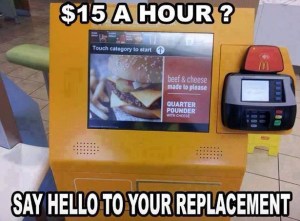
I know. Your grandma would never figure this thing out. But that’s hardly a compelling argument against it, and I’ll tell you why. Chiefly, this is generation one. Well, maybe two or three. But you get the point. It’s a germ of an idea. And yes, it has it’s flaws. A simple (dumb) touch-screen with menu options, and an attached debit machine is hardly a perturbing innovation. But the current setup is not what’s important about this. The fact that it exists at all should be deeply troubling to anyone working in fast food, and especially to those railing for a $15 an hour minimum wage. The refinement will come, in the same way we went from a five pound plastic brick to the sleek and stylish smartphones that receive so much of our attention nowadays. The creation of an intuitive interface, and an intelligent operating system is only a matter of time. Consider that we (and by we, of course, I mean humanity… but specifically, IBM) have created a computer which can literally comprehend Jeopardy questions in real time. Most humans struggle with that from time to time. Now that’s not to say that it’s perfect, but Watson did mop the floor with humanity’s two best champions. So that says something. More importantly (and to get back to fast food), they’ve also released a public API for Watson. What that means is that it’s pretty likely you’ll be seeing a similar degree of comprehension from your McFastFood terminals before long. Or in other words, you could simply say to it “Give me a combo five, hold the pickles, with a diet root-beer and an apple turnover. Oh, and hold the ice. And you know what, on second thought, I’ll have a spicy chicken wrap with that too.”

But the fun doesn’t stop at the counter. Momentum Machines has released a prototype of a device which actually makes the burger. From start to finish, however you like. Cooked and charred to perfection. Oh, and it will also slice the pickles at the time of order, and their next revision promises custom meat grinds.

Want a patty with 1/3 pork and 2/3 bison ground to order? No problem.

Try asking the wage-slave at your local burger joint for a 1/3 pork and 2/3 bison burger. Methinks you’d get a blank stare. But more to the point, there’s no reason it will stop with hamburgers. We’re just getting started. Restaurants could easily automate the production of everything from the boxes to french fries. And they will if those pesky humans keep demanding more money.

Will increasing the minimum wage to $15 an hour result in a mass exodus of fast-food workers? Probably not. But what it will do is increase the willingness (and by that I mean the amount of money being spent) of corporations to automate. The more cash that can be made coming up with novel solutions to repetitive low-skill tasks, well, the more solutions.

How many people work in fast food globally? How many young people get their start, both financially, and from an experience standpoint by hawking burgers? That could be coming to an end. Another blow to the younger generations, who not too long ago, worked right alongside their parents learning a skill or trade, only to be relegated to scraping the grill and asking “Do you want fries with that?”. What will they do next? More importantly, if the common consensus is that a McJob aught to pay $15 an hour, will they not demand similar compensation for whatever demeaning task we assign to them next, and similarly, will that not increase the incentive to automate that too? We’re at a crossroads of cost of living and cost to automate. The former increases regularly, the latter decreases almost daily. It doesn’t take a crystal ball to see how this is going to play out.

To answer my question from earlier, there are approximately 4.1 million people employed in food preparation in the USA. Some quick Google math reveals this to be about 12% of the total population. I doubt that includes management, who are also pretty likely to get the sack, as automated systems tend to produce a tonne of data which can be used to refine and improve operation.

Let me clarify. I think this is all a good thing. Fast food jobs suck. Humans are capable of, and deserve so much more. Being relegated to mind-numbing, underpaid busywork I wouldn’t wish on anyone. But at some point we have to step back and realize: Robots are making our food. (Or at least they will be soon.)

I happen to believe that very soon, the whole process, from the growth of the ingredients, to the packaging, warehousing, and transportation, will be automatic. This is mostly true already of the dairy industry. A handful of people can tend to hundreds of cows using highly sophisticated machinery, which can manage feeding, grooming, cleaning, milking, refuse-cleanup, and many other relevant tasks. The same will soon be true of everything from the growth and harvest of tomatoes to the production of the bun.

If we reach a point where it’s all (or at least mostly) done by machine, does it really make sense that there be one predominant entity at the helm, and more importantly, benefiting financially from the system? It’s taken the work of many hundreds of individuals to get us this far, most of whom saw minimal payoff for their labor and ideas which now belong to someone else. At some point, there will be a large segment of the population who have been displaced from their low-skill jobs and can no longer afford to purchase these goods. In some cases, it will be squarely their own fault due to poor life choices or a multitude of other pitfalls. But in a great many of those cases, the factors leading to their position will have been entirely out of their control. What of these individuals? What do they eat?

Unless the decision is made that the capability to create an abundance of food automatically aught to be used to feed those who are hungry, instead of feed the bank accounts of those fortunate enough to sit atop the pyramid, I foresee a great many hopeless, bored, hungry folks eying a system which is easily capable of feeding them. Whether they will take care to maintain that system while their dismantling it’s owners is anyone’s guess. But it’s plainly obvious where things are heading. We aught not ignore this reality much longer, or the consequences could be most disastrous.