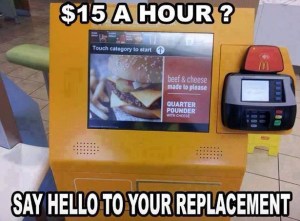
I know. Your grandma would never figure this thing out. But that’s hardly a compelling argument against it, and I’ll tell you why. Chiefly, this is generation one. Well, maybe two or three. But you get the point. It’s a germ of an idea. And yes, it has it’s flaws. A simple (dumb) touch-screen with menu options, and an attached debit machine is hardly a perturbing innovation. But the current setup is not what’s important about this. The fact that it exists at all should be deeply troubling to anyone working in fast food, and especially to those railing for a $15 an hour minimum wage. The refinement will come, in the same way we went from a five pound plastic brick to the sleek and stylish smartphones that receive so much of our attention nowadays. The creation of an intuitive interface, and an intelligent operating system is only a matter of time. Consider that we (and by we, of course, I mean humanity… but specifically, IBM) have created a computer which can literally comprehend Jeopardy questions in real time. Most humans struggle with that from time to time. Now that’s not to say that it’s perfect, but Watson did mop the floor with humanity’s two best champions. So that says something. More importantly (and to get back to fast food), they’ve also released a public API for Watson. What that means is that it’s pretty likely you’ll be seeing a similar degree of comprehension from your McFastFood terminals before long. Or in other words, you could simply say to it “Give me a combo five, hold the pickles, with a diet root-beer and an apple turnover. Oh, and hold the ice. And you know what, on second thought, I’ll have a spicy chicken wrap with that too.”
But the fun doesn’t stop at the counter. Momentum Machines has released a prototype of a device which actually makes the burger. From start to finish, however you like. Cooked and charred to perfection. Oh, and it will also slice the pickles at the time of order, and their next revision promises custom meat grinds.
Want a patty with 1/3 pork and 2/3 bison ground to order? No problem.
Try asking the wage-slave at your local burger joint for a 1/3 pork and 2/3 bison burger. Methinks you’d get a blank stare. But more to the point, there’s no reason it will stop with hamburgers. We’re just getting started. Restaurants could easily automate the production of everything from the boxes to french fries. And they will if those pesky humans keep demanding more money.
Will increasing the minimum wage to $15 an hour result in a mass exodus of fast-food workers? Probably not. But what it will do is increase the willingness (and by that I mean the amount of money being spent) of corporations to automate. The more cash that can be made coming up with novel solutions to repetitive low-skill tasks, well, the more solutions.
How many people work in fast food globally? How many young people get their start, both financially, and from an experience standpoint by hawking burgers? That could be coming to an end. Another blow to the younger generations, who not too long ago, worked right alongside their parents learning a skill or trade, only to be relegated to scraping the grill and asking “Do you want fries with that?”. What will they do next? More importantly, if the common consensus is that a McJob aught to pay $15 an hour, will they not demand similar compensation for whatever demeaning task we assign to them next, and similarly, will that not increase the incentive to automate that too? We’re at a crossroads of cost of living and cost to automate. The former increases regularly, the latter decreases almost daily. It doesn’t take a crystal ball to see how this is going to play out.
To answer my question from earlier, there are approximately 4.1 million people employed in food preparation in the USA. Some quick Google math reveals this to be about 12% of the total population. I doubt that includes management, who are also pretty likely to get the sack, as automated systems tend to produce a tonne of data which can be used to refine and improve operation.
Let me clarify. I think this is all a good thing. Fast food jobs suck. Humans are capable of, and deserve so much more. Being relegated to mind-numbing, underpaid busywork I wouldn’t wish on anyone. But at some point we have to step back and realize: Robots are making our food. (Or at least they will be soon.)
I happen to believe that very soon, the whole process, from the growth of the ingredients, to the packaging, warehousing, and transportation, will be automatic. This is mostly true already of the dairy industry. A handful of people can tend to hundreds of cows using highly sophisticated machinery, which can manage feeding, grooming, cleaning, milking, refuse-cleanup, and many other relevant tasks. The same will soon be true of everything from the growth and harvest of tomatoes to the production of the bun.
If we reach a point where it’s all (or at least mostly) done by machine, does it really make sense that there be one predominant entity at the helm, and more importantly, benefiting financially from the system? It’s taken the work of many hundreds of individuals to get us this far, most of whom saw minimal payoff for their labor and ideas which now belong to someone else. At some point, there will be a large segment of the population who have been displaced from their low-skill jobs and can no longer afford to purchase these goods. In some cases, it will be squarely their own fault due to poor life choices or a multitude of other pitfalls. But in a great many of those cases, the factors leading to their position will have been entirely out of their control. What of these individuals? What do they eat?
Unless the decision is made that the capability to create an abundance of food automatically aught to be used to feed those who are hungry, instead of feed the bank accounts of those fortunate enough to sit atop the pyramid, I foresee a great many hopeless, bored, hungry folks eying a system which is easily capable of feeding them. Whether they will take care to maintain that system while their dismantling it’s owners is anyone’s guess. But it’s plainly obvious where things are heading. We aught not ignore this reality much longer, or the consequences could be most disastrous.
 Thought Automaton
The funny thing here: the domain of understanding what to order is basically a solved problem and tools like Watson aren’t really even needed for this to work.
McDonalds has a remote answering service for their drive throughs where they’ve been systematically recording and cataloguing almost all requests and applying machine learning to it.
Refer to http://www.nytimes.com/2006/04/11/technology/11fast.html from 2006… the future is already here.